


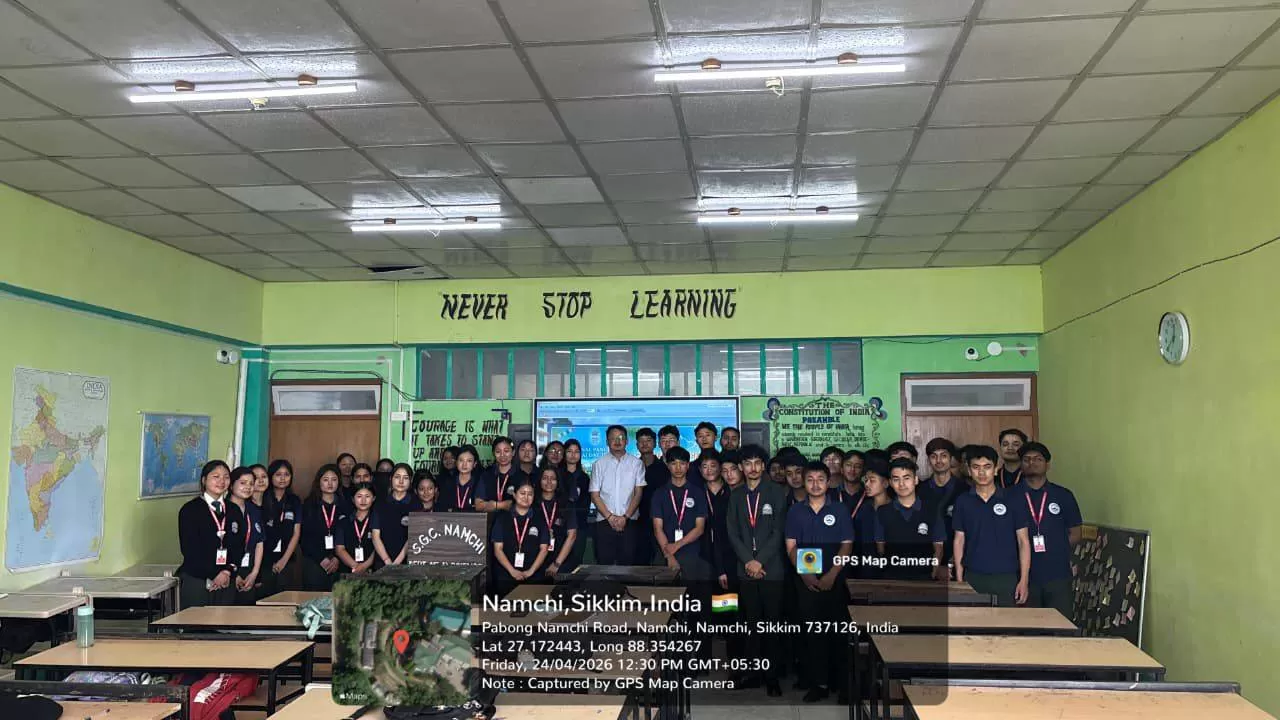
On 24th April 2026, the Department of Political Science, Sikkim Government College, Namchi organised a series of talks to commemorate National Panchayati Raj Day celebrating over three decades of democratic decentralization.
On this occasion faculty members of the department of Political Science delivered lectures to the students of second, fourth and sixth semester on the topic Panchayati Raj Institutions and local self governance in India. The event aimed to enhance students’ understanding of local self-government and functioning of Panchayati Raj Institution in India.
Dr. Bitu Subba delivered a lecture to the 6th Semester students on the topic Panchayati Raj Institutions and Sikkim: Its relevance and adaptation. The lecture covered the basic aspects of Panchayati Raj Institution as envisioned by the father of our nation Mahatma Gandhi Gram Swaraj. The topic covered 73rd Amendment Act, Eleventh Schedule, Three F’s: Functions, Funds and Functionaries, its implementation at the grassroot level and its implementation in the state of Sikkim. The lecture also covered the traditional system of Dzumsa practiced in Mangan District of Sikkim in the area of Lachen and Lachung.
Mr. Rosden T. Bhutia addressed the 4th semester students, speaking on Panchayati Raj Institutions with special emphasis on the Dzumsa system in Sikkim. He explained the traditional governance system, its structure and its relevance in contemporary times.
Dr. Panu O. Pazo had instructed the students 2 days in advance to prepare for Quiz on the Panchayati Raj system. On the designated day, the 2nd semester class was divided into 6 groups, A-F based on the students’ roll numbers. A total of 4 rounds of quiz was conducted: i) history and constitutional foundations, ii) structure and compositions, iii) power and functions, and iv) elections, representations and reservations.Dr. Pazo ended the Quiz with a wild card round where questions were thrown open to the students. The winning team was A, followed by C and group D and B tied for the third place. The final part was a short delivery on the contemporary challenges and reforms to the Panchayati Raj system.
The session brought excitement and participation of all the students. Overall, the session was very fruitful and interactive as it celebrated the deepening of democracy at the grassroot level.